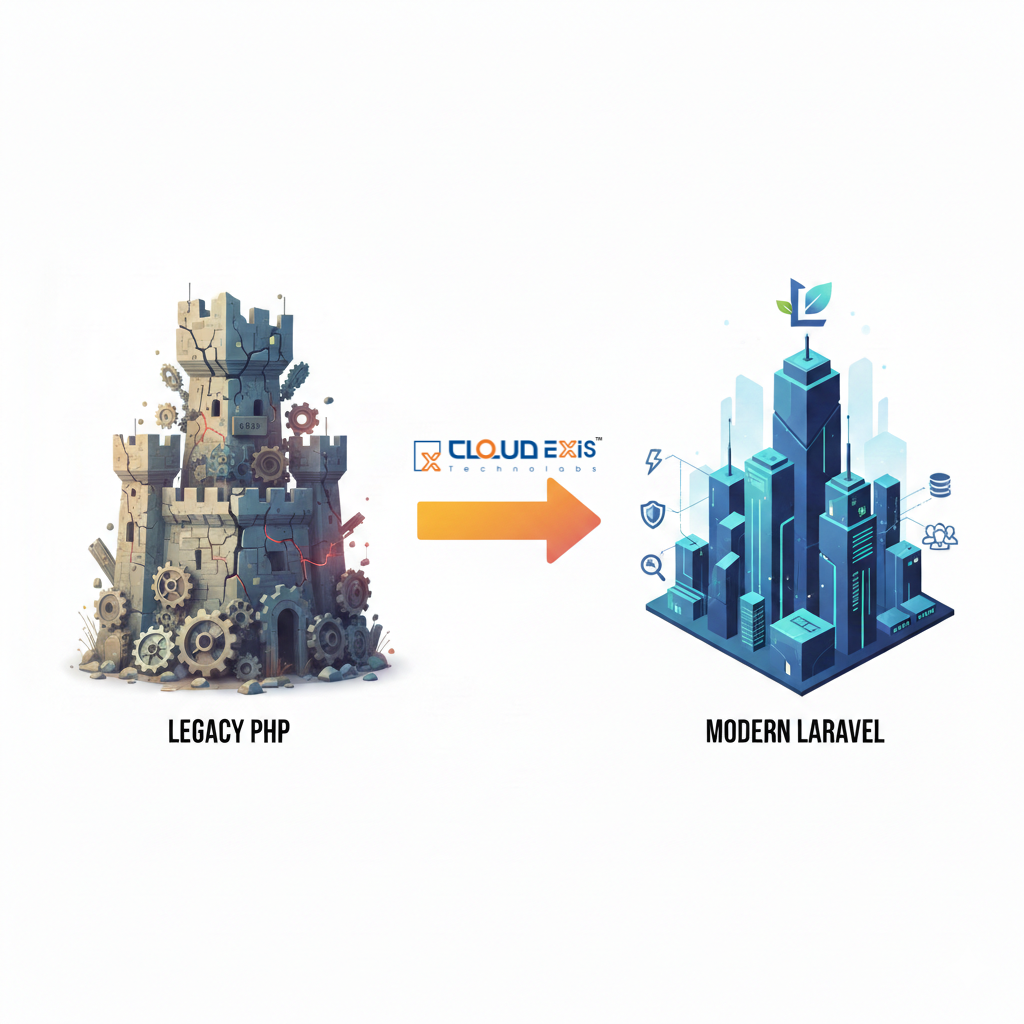
Introduction: Why Legacy PHP Systems Are Holding Businesses Back
Over the last decade, PHP has powered millions of web applications across industries CRMs, ERPs, eCommerce platforms, portals, and SaaS products. Frameworks like CakePHP, Zend Framework, CodeIgniter, and early Laravel versions were once the backbone of modern development.
But technology doesn’t stand still.
Today, many businesses are struggling with:
Slow feature development
Security vulnerabilities
Difficulty hiring experienced developers
Poor scalability and performance
Outdated user experiences
This is why PHP framework migration has become a high-priority initiative for startups, SMBs, and enterprises alike.
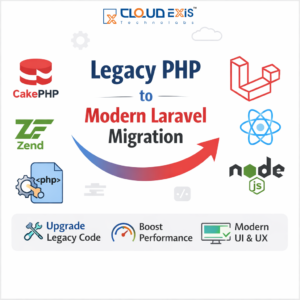
At Cloudexis Technolabs, we specialize in migrating legacy PHP applications including CakePHP, Zend, Custom PHP, and old Laravel versions to modern Laravel, Laravel + React/Vue, or Laravel + Node.js architectures without disrupting business operations.
This guide explains why migration matters, which path is right for your business, and how a structured migration delivers long-term value.
What Is Legacy PHP (and Why It’s a Risk in 2026)?
Legacy PHP systems typically include:
CakePHP 2.x / early 3.x
Zend Framework (ZF1, ZF2, ZF3)
CodeIgniter 2/3
Custom PHP MVC frameworks
Laravel 4, 5.x, or early 6.x applications
While these systems may still “work,” they introduce serious risks:
1. Security Vulnerabilities
Older frameworks often rely on unsupported PHP versions and unpatched dependencies, increasing exposure to security threats and compliance risks.
2. Limited Scalability
Legacy architectures were not designed for modern traffic patterns, API-first platforms, or real-time features.
3. High Maintenance Costs
Small changes require deep system knowledge. Bug fixes take longer. Technical debt keeps growing.
4. Hiring Challenges
It’s increasingly difficult to find developers who want or know how to maintain outdated PHP stacks.
5. Poor User Experience
Legacy systems struggle to deliver fast, responsive, modern UI experiences expected by today’s users.
Why Laravel Has Become the Preferred Migration Destination
Laravel has evolved into the most widely adopted PHP framework globally and for good reason.
Key Advantages of Modern Laravel
Clean MVC architecture
Strong security defaults
Massive ecosystem (queues, jobs, APIs, auth, caching)
First-class API development
Seamless integration with React, Vue, and Node.js
Excellent performance with PHP 8+
Easy onboarding for developers
For businesses, Laravel offers speed, stability, and future-proofing, making it the ideal destination for legacy PHP migrations.
Common PHP Migration Scenarios We Handle
1. CakePHP to Laravel Migration
CakePHP applications, especially older versions, often face:
Tight coupling
Limited ecosystem growth
Slower modernization paths
Migration approach:
Rebuild business logic using Laravel services
Gradually migrate controllers and models
Preserve database structure where possible
Modernize UI with Blade, Vue, or React
Best for: CRM systems, admin panels, internal tools, SaaS backends
2. Zend Framework to Laravel or Modern API Architecture
Zend applications are commonly found in enterprise systems and long-running platforms.
Migration options:
Zend → Laravel (full modernization)
Zend → Laravel API + React frontend
Zend → Laravel backend + Node.js services (for real-time needs)
Why clients migrate:
Reduced development complexity
Better hiring pool
Faster feature rollout
Improved maintainability
3. Custom PHP to Laravel Migration
Custom PHP frameworks often lack:
Documentation
Testing
Security best practices
Upgrade paths
Our strategy:
Reverse-engineer existing business logic
Design clean Laravel modules
Introduce coding standards and testing
Improve performance and security
Result: A maintainable, scalable system built on industry standards.
4. Old Laravel to Latest Laravel Upgrade
Even Laravel applications can become legacy if not maintained.
Common issues:
Deprecated packages
PHP version incompatibility
Performance bottlenecks
Security gaps
Upgrade benefits:
PHP 8+ performance gains
Cleaner codebase
Improved APIs
Long-term support stability
Choosing the Right Migration Architecture
Not every business needs the same architecture. Choosing the right one is critical.
Option 1: Laravel Monolith (Best for Most Businesses)
Ideal for:
B2B platforms
Admin dashboards
SaaS products
Internal systems
Benefits:
Faster development
Lower infrastructure cost
Simpler maintenance
Easier onboarding
This is often the most cost-effective and stable choice.
Option 2: Laravel + React or Vue (Modern Frontend Experience)
Ideal for:
Customer-facing platforms
SaaS products with heavy UI interaction
Multi-role dashboards
Benefits:
Faster UI performance
Better UX
Frontend/backend separation
Scalability for future growth
Option 3: Laravel + Node.js (Hybrid Architecture)
Ideal for:
Real-time applications
Chat systems
Event-driven platforms
Heavy API traffic
Benefits:
High concurrency
Real-time communication
Microservice flexibility
Laravel remains the core backend, while Node handles real-time workloads.
Our Proven Migration Process at Cloudexis Technolabs
We don’t believe in risky “big-bang” rewrites.
Step 1: Legacy System Audit
Code quality assessment
Security review
Performance analysis
Database evaluation
Step 2: Migration Strategy & Architecture
Decide monolith vs API vs hybrid
Define phased or full migration
Create migration roadmap
Step 3: Data & Logic Mapping
Identify reusable business logic
Map legacy workflows to Laravel services
Plan schema optimizations (if required)
Step 4: Phased Development
Migrate modules incrementally
Maintain system availability
Minimize downtime
Step 5: Testing & Validation
Functional testing
Data integrity checks
Performance benchmarking
Step 6: Deployment & Post-Launch Support
CI/CD setup
Monitoring & optimization
Ongoing enhancements
Business Benefits of Migrating to Modern Laravel
✔ Faster Time to Market
New features launch in weeks instead of months.
✔ Improved Security & Compliance
Modern PHP versions, secure defaults, and updated dependencies.
✔ Lower Long-Term Costs
Cleaner code = less maintenance = lower operational expense.
✔ Easier Hiring & Scaling
Laravel developers are widely available globally.
✔ Better Performance & UX
Optimized APIs, caching, queues, and modern frontend experiences.
Why Choose Cloudexis Technolabs?
At Cloudexis Technolabs LLP, we’re not just developers. We’re migration partners.
Deep expertise in PHP, Laravel, React, Vue, and Node.js
Proven experience with B2B platforms, SaaS, healthcare, LMS, and enterprise systems
Structured, low-risk migration approach
Transparent communication and long-term support mindset
Whether you’re running a legacy CakePHP app, a Zend-based enterprise platform, or an outdated Laravel system, we help you move forward with confidence.
Final Thoughts: Migration Is an Investment, Not a Cost
Legacy systems slow growth. Modern platforms enable it.
Migrating to Laravel or a modern hybrid architecture isn’t just about upgrading technology. It’s about:
Unlocking scalability
Improving user experience
Reducing operational risk
Preparing your business for the next 5–10 years
If your current PHP system feels hard to maintain, expensive to extend, or risky to scale. it’s time to modernize.
Ready to Modernize Your PHP Application?
Contact Cloudexis Technolabs LLP to discuss your legacy PHP migration strategy and get a clear roadmap tailored to your business.