In today’s fast-paced business environment, companies are constantly searching for ways to reduce operational costs without compromising performance or growth. Rising labor costs, increasing competition, and the demand for faster execution have made traditional operational models less sustainable. Businesses can no longer rely solely on manual processes or outdated systems to stay competitive.
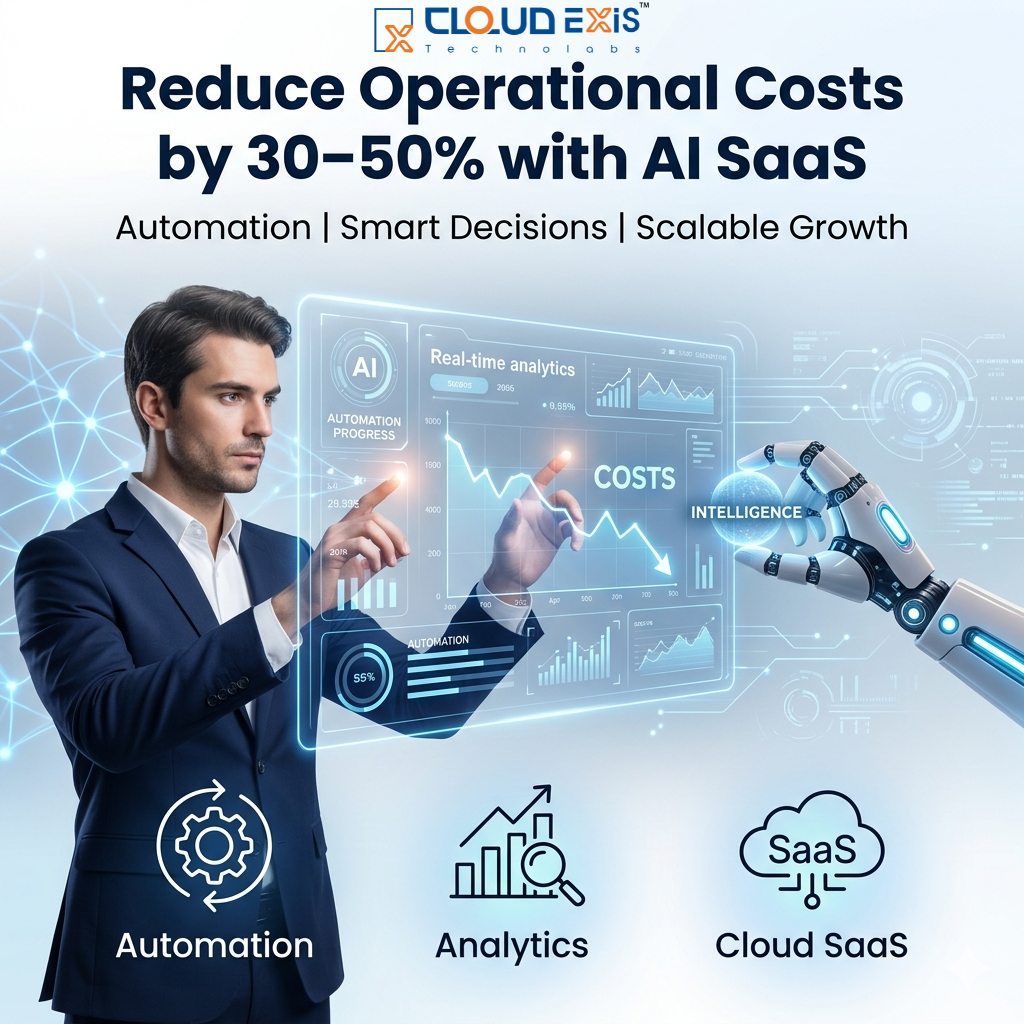
This is where AI-powered SaaS platforms are making a significant impact. By combining the flexibility of cloud-based software with the intelligence of artificial intelligence, these platforms are helping organizations streamline operations, eliminate inefficiencies, and improve decision-making. The result is not just optimization, but measurable cost savings that can reach 30% to 50% across various business functions.
Unlike traditional software, AI-powered SaaS solutions do not simply perform tasks. They continuously learn from data, adapt to changing conditions, and improve outcomes over time. This ability to evolve makes them particularly valuable for businesses aiming to scale efficiently while maintaining control over operational expenses.
Understanding AI-Powered SaaS in a Business Context
AI-powered SaaS platforms are designed to go beyond basic automation. They integrate advanced technologies such as machine learning, natural language processing, and predictive analytics into cloud-based systems. This allows businesses to move from reactive operations to proactive and intelligent workflows.
For example, instead of manually reviewing customer data to identify opportunities, an AI-powered SaaS platform can automatically analyze behavior patterns, predict future actions, and recommend the next best steps. This level of intelligence reduces dependency on manual effort and significantly enhances efficiency.
More importantly, these platforms centralize operations, enabling businesses to manage multiple functions such as customer engagement, analytics, and workflow automation from a single system. This consolidation alone plays a major role in reducing operational overhead.
Why Operational Costs Are Rising in Modern Businesses
Many organizations struggle with hidden inefficiencies that gradually increase operational costs. These inefficiencies are often not immediately visible but accumulate over time, affecting profitability and scalability.
Businesses frequently deal with:
- Repetitive manual processes that consume valuable time
- Disconnected systems that create data silos
- Over-reliance on human intervention for routine tasks
- Delayed decision-making due to lack of real-time insights
- High customer support costs due to increasing demand
These challenges not only slow down operations but also lead to unnecessary expenses. AI-powered SaaS platforms address these issues at their core by introducing automation, integration, and intelligence into everyday business processes.
Automating Workflows to Reduce Manual Effort
One of the most immediate and noticeable benefits of AI-powered SaaS is the ability to automate repetitive tasks. In traditional setups, teams spend a significant portion of their time on activities that do not directly contribute to growth, such as data entry, report generation, and routine communication.
AI-driven automation eliminates these inefficiencies by handling tasks with speed and accuracy. For instance, customer queries can be managed by intelligent chat systems, reports can be generated automatically, and workflows can be triggered based on predefined conditions. This reduces the need for manual intervention and allows employees to focus on more strategic responsibilities.
Over time, this shift leads to reduced labor costs, improved productivity, and faster execution. Businesses are able to achieve more with fewer resources, which directly contributes to cost reduction.
Enhancing Decision-Making with Real-Time Intelligence
Decision-making is a critical factor in operational efficiency, yet many businesses still rely on outdated reports and assumptions. AI-powered SaaS platforms transform this process by providing real-time insights and predictive analytics.
Instead of analyzing what has already happened, businesses can now anticipate future trends and make informed decisions proactively. For example, AI can identify patterns in customer behavior, forecast demand, and highlight potential risks before they escalate.
This level of intelligence minimizes costly mistakes and ensures that resources are allocated effectively. When decisions are driven by data rather than guesswork, businesses can optimize their operations and improve overall financial performance.
Transforming Customer Support Without Increasing Costs
Customer support is often one of the most resource-intensive areas of a business. As customer expectations grow, companies are required to provide faster and more efficient responses, which typically leads to higher staffing costs.
AI-powered SaaS platforms address this challenge by enabling automated support systems that operate around the clock. These systems can handle a large volume of queries simultaneously, provide instant responses, and escalate complex issues to human agents when necessary.
This approach not only reduces the need for large support teams but also improves response times and customer satisfaction. Businesses can maintain high-quality support services without significantly increasing operational expenses.
Consolidating Tools and Reducing Software Costs
Many businesses rely on multiple software tools for different functions, such as CRM, marketing automation, analytics, and project management. While these tools serve specific purposes, they often lead to higher subscription costs and fragmented workflows.
AI-powered SaaS platforms offer a more integrated approach by combining multiple functionalities into a single system. This reduces the need for multiple subscriptions and ensures seamless data flow across departments.
Key advantages of consolidation include:
- Lower software subscription costs
- Improved data accuracy and accessibility
- Streamlined workflows across teams
- Reduced complexity in system management
By simplifying the technology stack, businesses can reduce both direct and indirect costs while improving operational efficiency.
Operating with Leaner Teams and Higher Productivity
One of the most significant cost-saving opportunities comes from reducing dependency on large teams for routine tasks. Hiring, training, and managing employees involves substantial costs, including salaries, infrastructure, and administrative overhead.
AI-powered SaaS platforms enable businesses to operate with leaner teams by automating repetitive tasks and enhancing productivity. Employees can focus on high-value activities such as strategy, innovation, and customer engagement, rather than spending time on routine operations.
This shift not only reduces payroll expenses but also improves the overall efficiency of the organization. With the right AI-driven tools, businesses can achieve more with a smaller, more focused team.
Scaling Operations Without Proportional Cost Increase
Scalability is a major challenge for growing businesses. Traditional systems often require additional resources as the business expands, leading to increased costs. AI-powered SaaS platforms, however, are designed to scale effortlessly.
As the volume of data and operations increases, these platforms adapt automatically without requiring significant infrastructure changes. This ensures that growth does not lead to a proportional increase in operational expenses.
In fact, many businesses experience improved efficiency as they scale, thanks to the continuous learning capabilities of AI systems. This makes AI-powered SaaS an ideal solution for companies aiming for sustainable growth.
Reducing Risks Through Predictive Capabilities
Operational disruptions can be costly, whether they are caused by system failures, customer churn, or market fluctuations. AI-powered SaaS platforms help mitigate these risks by identifying potential issues before they occur.
By analyzing patterns and detecting anomalies, AI systems can provide early warnings and recommend corrective actions. This proactive approach allows businesses to avoid costly disruptions and maintain smooth operations.
Over time, this risk reduction contributes significantly to overall cost savings and business stability.
Real-World Impact Across Industries
AI-powered SaaS platforms are delivering tangible results across various industries. In healthcare, they streamline appointment scheduling and patient management, reducing administrative costs. In education, they automate assessments and personalize learning experiences, improving efficiency for both institutions and learners.
In logistics, AI optimizes routes and predicts delays, leading to better resource utilization and reduced operational expenses. Similarly, in CRM and sales platforms, AI enhances lead management and improves conversion rates, directly impacting revenue and cost efficiency.
Across all these sectors, the common factor is the ability of AI-powered SaaS to replace manual effort with intelligent automation.
How Businesses Achieve 30–50% Cost Reduction
The significant cost savings associated with AI-powered SaaS platforms are not the result of a single change, but rather a combination of multiple improvements across the organization.
Businesses typically achieve savings through:
- Automation of repetitive tasks and workflows
- Reduction in labor and staffing requirements
- Lower software and infrastructure costs
- Improved decision-making and resource allocation
- Minimization of errors and operational risks
When these factors work together, the cumulative impact leads to substantial reductions in operational costs.
Important Considerations Before Implementation
While the benefits are compelling, businesses should approach AI SaaS implementation strategically. It is important to ensure that data quality is maintained, systems are properly integrated, and teams are prepared for the transition.
Working with an experienced development partner can make a significant difference in overcoming these challenges and maximizing the return on investment.
Why Custom AI SaaS Solutions Deliver Better ROI
Off-the-shelf solutions may offer quick deployment, but they often lack the flexibility required to address specific business needs. Custom AI-powered SaaS platforms, on the other hand, are designed to align perfectly with existing workflows and objectives.
This level of customization allows businesses to achieve higher efficiency, better scalability, and a stronger competitive advantage. It also ensures that the solution evolves alongside the business, delivering long-term value.
How Cloudexis Technolabs LLP Can Help
At Cloudexis Technolabs LLP, we specialize in building AI-powered SaaS platforms tailored to real business challenges. Our approach focuses on identifying inefficiencies, designing scalable solutions, and delivering measurable outcomes.
We have extensive experience in developing solutions such as AI-driven healthcare platforms, LMS systems, CRM applications, and enterprise tools. By integrating AI into these systems, we help businesses automate operations, improve decision-making, and reduce costs effectively.
Our goal is to act as a long-term technology partner, enabling organizations to scale efficiently while maintaining control over operational expenses.
Conclusion: Smarter Operations, Stronger Growth
Reducing operational costs is no longer about cutting resources. it’s about optimizing how work gets done. AI-powered SaaS platforms provide a powerful combination of automation, intelligence, and scalability, allowing businesses to operate more efficiently and effectively.
By adopting these solutions, companies can achieve significant cost savings while improving performance, customer experience, and overall growth. The future of business operations lies in intelligent systems that not only support but actively enhance decision-making and execution.
For organizations looking to stay competitive in 2026 and beyond, investing in AI-powered SaaS is not just an option. It’s a strategic necessity.
FAQs
1. How long does it take to see ROI from AI-powered SaaS?
Most businesses start seeing measurable results within a few months, depending on the complexity of implementation.
2. Can small businesses benefit from AI SaaS?
Yes, AI-powered SaaS solutions are scalable and can be customized to fit businesses of all sizes.
3. Is integration with existing systems possible?
Modern AI SaaS platforms are designed to integrate seamlessly with existing tools and workflows.
4. What industries benefit the most?
Healthcare, education, logistics, finance, and e-commerce are among the top industries benefiting from AI SaaS.
5. Do businesses need in-house AI expertise?
Not necessarily. Partnering with an experienced development company can simplify implementation and management.