Introduction
Artificial Intelligence is changing software development faster than almost any technology shift we have seen in the last decade. What started as simple autocomplete suggestions has now evolved into advanced AI agents capable of generating APIs, creating React interfaces, writing SQL queries, producing documentation, and even debugging applications. Today, terms like AI agents in software development, AI-assisted coding, and intent-driven software lifecycle are becoming central discussions among startups, CTOs, enterprise companies, and development agencies.
But beneath all the excitement, there’s a serious question businesses need to ask:
Can AI agents actually maintain a real enterprise application?
As a software development agency working with AI platforms, SaaS systems, healthcare products, LMS solutions, logistics software, and enterprise-grade applications, we’ve experienced both the strengths and limitations of AI-driven development firsthand. The reality is much more balanced than the internet hype suggests. AI tools can dramatically speed up development in certain areas, but they also fail badly when projects involve scalability, security, architecture, compliance, and long-term maintenance.
The future of software development is not about replacing engineers completely. Instead, it’s about combining human expertise with AI-powered productivity. Understanding where AI succeeds and where it struggles is becoming extremely important for modern businesses investing in digital transformation.
Understanding Intent-Driven Software Development
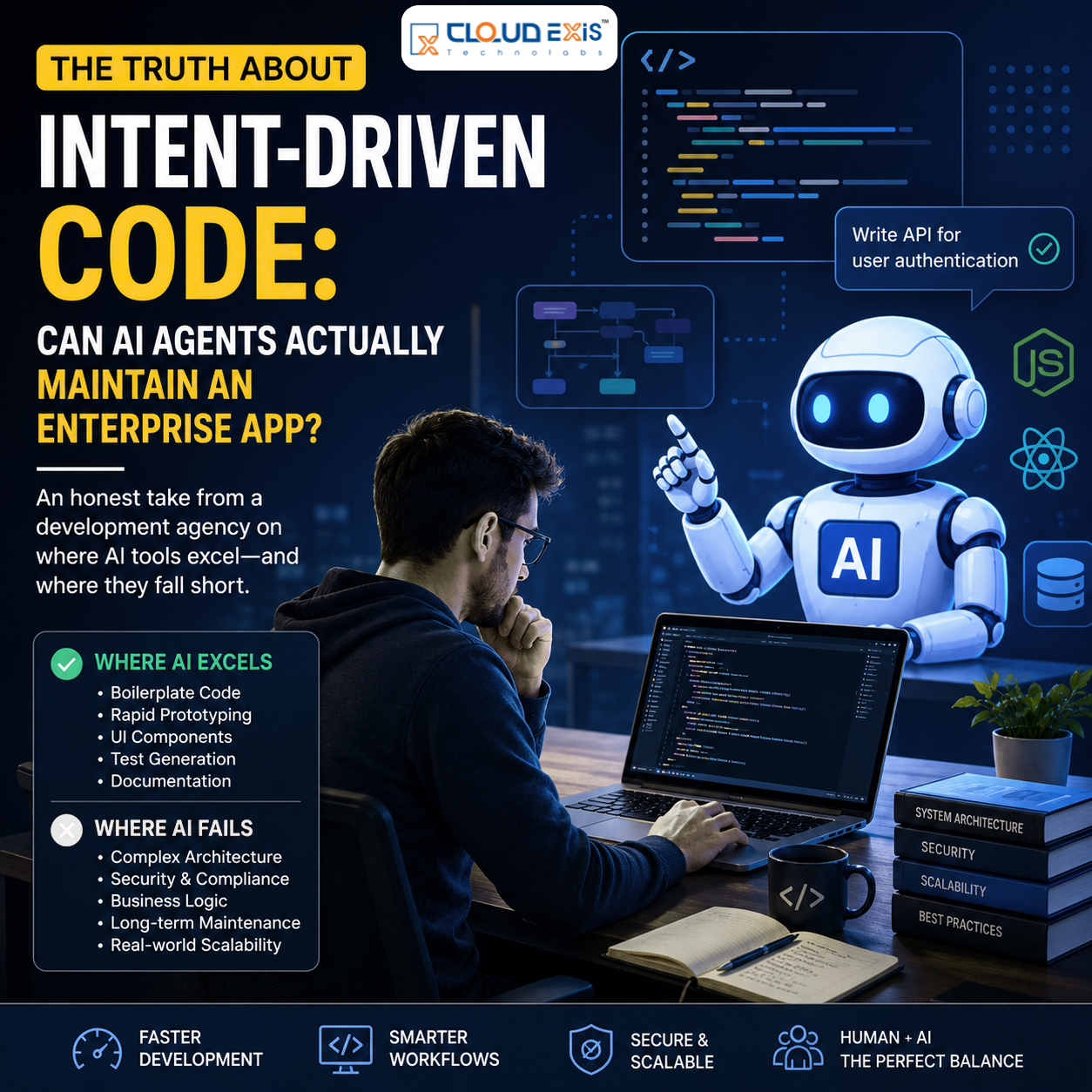
Intent-driven software development is the idea that developers can describe what they want in plain language, and AI systems generate the implementation automatically. Instead of manually writing every component, developers communicate high-level goals and let AI handle repetitive engineering tasks.
For example, a developer may simply request:
- Build a Node.js REST API with JWT authentication
- Create a responsive React dashboard
- Generate an admin panel with role-based permissions
- Add chatbot integration into an existing CRM
The AI agent interprets the request and generates working code within seconds.
This approach is transforming the traditional software lifecycle. In many modern workflows, developers are moving from writing every line manually to supervising, refining, and validating AI-generated code. The result is a dramatic increase in development speed, especially for repetitive tasks.
The rise of tools like GitHub Copilot, Cursor AI, Devin AI, and OpenAI-powered development assistants has accelerated this movement significantly. Businesses are now exploring whether AI agents can reduce development costs, improve release speed, and even automate maintenance operations.
The answer, however, is more complicated than marketing claims suggest.
Where AI Agents Truly Improve Software Development
One of the biggest misconceptions about AI in programming is that it either completely replaces developers or has no value at all. In reality, AI tools are incredibly useful in specific areas of the development lifecycle.
The biggest advantage is speed.
AI agents are excellent at generating repetitive and structured code patterns. Tasks that once consumed hours can now be completed in minutes. This productivity boost is particularly valuable during MVP development, internal dashboard creation, and frontend scaffolding.
For example, when building modern web applications using React, Next.js, Laravel, or Node.js, AI can rapidly generate:
- Authentication modules
- CRUD operations
- API structures
- Database migrations
- Form validation logic
- Reusable UI components
- Basic test cases
This allows engineering teams to focus more on solving business problems instead of spending excessive time on boilerplate development.
In startup environments, where time-to-market is critical, AI-assisted development can provide a massive competitive advantage. Teams can validate product ideas faster, release prototypes quickly, and reduce repetitive coding effort during the early development phase.
Another area where AI tools genuinely help is documentation and refactoring. Many enterprise applications suffer from poor technical documentation, especially older systems maintained over several years. AI can analyze codebases, explain functions, generate API documentation, and even suggest refactoring opportunities to improve readability.
This becomes especially useful when onboarding new developers into large projects.
Testing is another area where AI provides measurable value. Writing test cases manually is time-consuming, and many teams avoid comprehensive testing because of delivery pressure. AI agents can automatically generate unit tests, API test scenarios, and edge-case suggestions, significantly reducing the manual effort required from QA teams.
From a productivity perspective, AI in software development is absolutely real and extremely valuable.
But productivity alone does not equal enterprise readiness.
The Enterprise Software Reality Most AI Discussions Ignore
Enterprise applications are fundamentally different from small demo projects or simple SaaS prototypes. Real enterprise software operates under complex conditions involving scalability, integrations, infrastructure, compliance, security, and long-term maintenance requirements.
This is where many AI-generated systems begin to break down.
A large enterprise application may involve multiple microservices, distributed databases, caching layers, event-driven systems, cloud orchestration, CI/CD pipelines, third-party integrations, monitoring systems, and role-based access structures. These systems evolve over the years and often support thousands or millions of users.
AI can generate isolated pieces of functionality, but enterprise success depends heavily on architectural decisions made over time.
This is one of the biggest weaknesses of current AI agents in software development.
AI tools usually lack a deep understanding of:
- Long-term scalability
- Infrastructure optimization
- Cross-service dependencies
- Cloud cost management
- Failover architecture
- Data consistency challenges
- Real production bottlenecks
An AI-generated module may work perfectly during testing but fail under enterprise-scale traffic conditions. This creates dangerous assumptions for companies believing AI can independently manage complex software ecosystems.
Architecture is not just code generation. It requires experience, planning, tradeoff analysis, and understanding how systems evolve over years of business growth.
AI currently struggles badly in this area.
Security: The Biggest Risk in AI-Generated Applications
Security is probably the most concerning issue in intent-driven software development today.
Many AI-generated applications appear functional on the surface but contain hidden vulnerabilities that become dangerous in production environments. AI agents frequently generate insecure authentication flows, weak validation mechanisms, outdated package dependencies, or improper permission handling.
In enterprise systems dealing with:
- Healthcare records
- Financial transactions
- Government platforms
- Payment systems
- User identity management
These vulnerabilities become extremely serious.
The problem is that AI models optimize for producing working code, not necessarily secure architecture.
For example, AI may generate:
- Hardcoded secrets
- Weak JWT implementations
- Poor access control logic
- Insecure API endpoints
- SQL injection vulnerabilities
- Improper session handling
These issues are not always obvious during development. Many only appear after penetration testing or during real-world attacks.
Human security review is still essential.
No responsible enterprise should rely solely on autonomous AI-generated architecture without experienced developers validating the system thoroughly. Security requires deep contextual understanding, threat modeling, infrastructure planning, and compliance awareness, areas where AI still has major limitations.
AI Still Does Not Understand Real Business Logic
Another major limitation of AI agents is business understanding.
Enterprise software is deeply tied to operational workflows and industry-specific logic. A healthcare application behaves differently from a logistics platform. A banking approval system is very different from a marketplace platform. Real business processes involve exceptions, regulations, approvals, dependencies, and years of accumulated operational experience.
AI tools can generate generic workflows, but they struggle to fully understand how businesses actually operate.
For example, in industries like:
- Insurance
- Healthcare
- Logistics
- Manufacturing
- Finance
- Government services
Business logic becomes extremely nuanced.
A human architect understands why certain workflows exist, why specific approvals are mandatory, and how operational risks impact system behavior. AI models lack this contextual business awareness.
This often leads to generated systems that technically function but fail operationally because they do not align with real-world business processes.
Enterprise software is not just about functionality.
It’s about aligning technology with organizational behavior.
That still requires human expertise.
The Long-Term Maintenance Problem
One of the biggest hidden dangers of AI-generated applications is long-term maintainability.
Initially, AI-generated code feels incredibly productive. Teams move fast, features get delivered quickly, and prototypes look impressive.
But after several months, many projects begin accumulating technical debt.
Common issues include:
- Inconsistent coding standards
- Duplicate business logic
- Poor folder organization
- Weak modular structure
- Difficult debugging flows
- Dependency confusion
- Over-engineered components
Enterprise software maintenance requires discipline, governance, architecture consistency, and long-term planning.
AI agents currently lack the strategic thinking needed to maintain code quality over large, evolving systems.
This is why experienced engineering leadership still matters enormously.
The Real Future of AI in Software Development
The future is not AI replacing software developers completely.
The future is AI-augmented engineering teams.
The most successful development companies today are already combining:
- AI-assisted coding
- Human architecture expertise
- Security-first engineering
- Automated testing
- Human QA validation
- Infrastructure governance
This hybrid model produces the best results.
AI accelerates execution.
Humans provide direction, architecture, security, and business understanding.
That balance is where real innovation happens.
Final Thoughts
AI agents in software development are genuinely transforming the software industry. Intent-driven coding is improving productivity, accelerating MVP launches, and reducing repetitive engineering effort across modern development teams.
But there is an enormous difference between generating code and maintaining enterprise-grade applications.
AI tools are excellent assistants.
They are not yet autonomous enterprise architects.
Businesses that understand this distinction will make smarter technology decisions in the coming years. The companies that succeed will not blindly replace engineers with AI. Instead, they will build strong engineering teams empowered by AI-driven productivity tools.
The future of the intent-driven software lifecycle is incredibly promising, but human expertise remains the foundation of secure, scalable, and maintainable enterprise software.
And for now, that reality is not changing anytime soon. Contact Us
FAQs
1. What is intent-driven software development?
Intent-driven software development is an AI-powered approach where developers describe what they want in plain language, and AI tools generate the required code, workflows, or components automatically. It helps accelerate development by reducing repetitive coding tasks.
2. Can AI agents fully replace software developers?
No, AI agents cannot fully replace experienced software developers, especially for enterprise applications. While AI tools are excellent for generating boilerplate code, UI components, and APIs, human expertise is still essential for architecture planning, security, scalability, and complex business logic.
3. Where do AI coding tools perform best in software development?
AI coding assistants perform best in areas like:
- React and Node.js boilerplate generation
- CRUD API development
- UI component creation
- Test case generation
- Documentation support
- Code refactoring
These tools significantly improve developer productivity and reduce development time.
4. What are the biggest risks of AI-generated enterprise applications?
The biggest risks include:
- Security vulnerabilities
- Poor system architecture
- Inconsistent code quality
- Scalability issues
- Weak business logic handling
- Long-term maintenance challenges
This is why enterprise software still requires human oversight and experienced engineering teams.
5. What is the future of AI agents in software development?
The future of AI in software development is AI-augmented engineering rather than full automation. Businesses will increasingly combine AI-powered coding tools with human architects, developers, and security experts to build faster, smarter, and more scalable enterprise applications.