Introduction
Technology has become one of the biggest drivers of business growth. From managing customer relationships and inventory to handling accounting and internal workflows, software plays a crucial role in how organizations operate. As businesses continue to evolve, choosing the right software becomes an important decision that directly impacts productivity, profitability, and long-term success.
Many organizations initially opt for off-the-shelf software because it appears affordable and can be implemented quickly. These solutions are designed for mass adoption and cater to a broad audience with generic features. While they may satisfy immediate requirements, businesses often discover that ready-made applications cannot fully support their unique processes, operational goals, and future expansion plans.
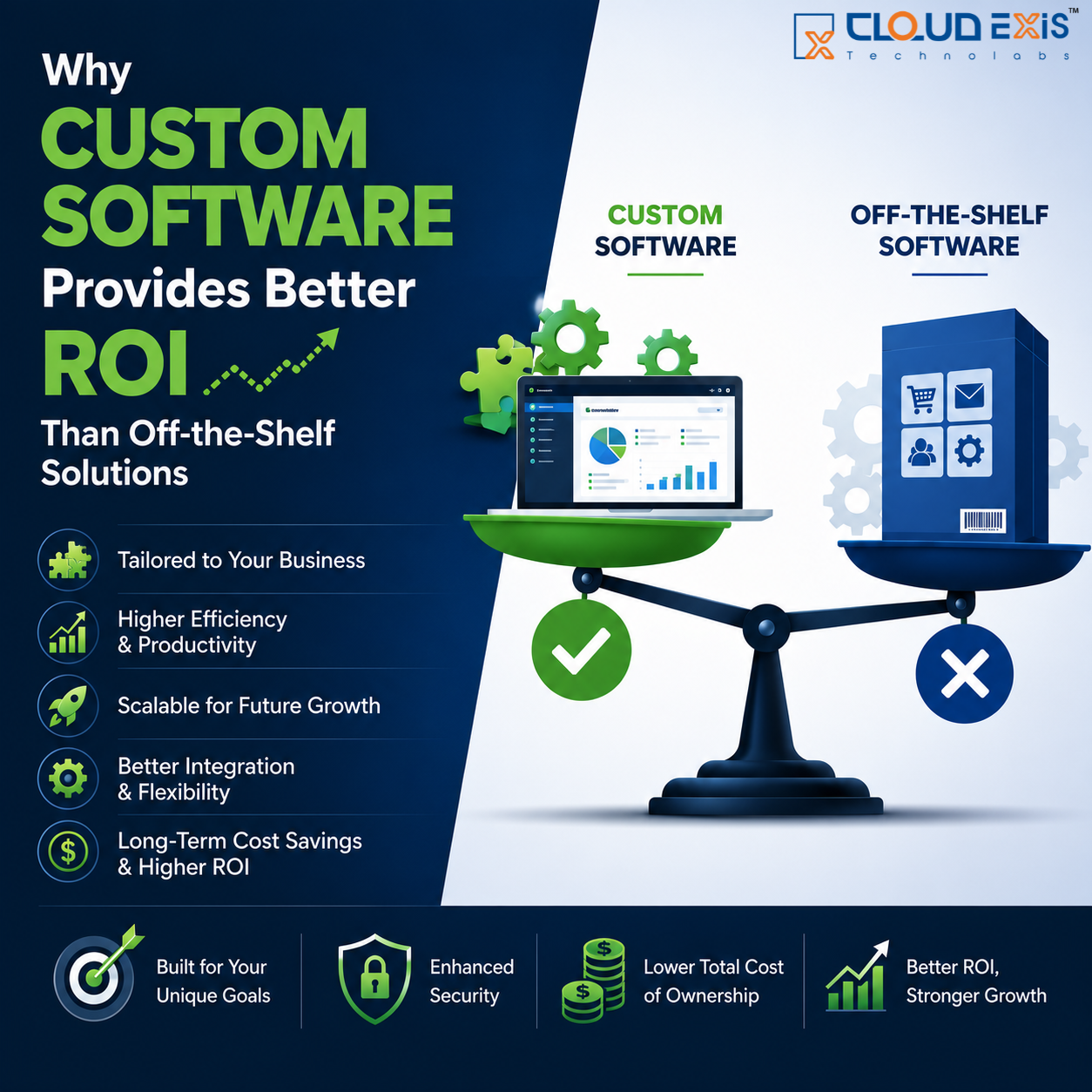
This is where custom software development offers a significant advantage. Unlike pre-packaged solutions, custom software is built specifically around the needs of a business. It provides flexibility, scalability, better efficiency, and long-term cost savings, making it a smarter investment in the long run.
Although custom software may require a higher initial investment, its ability to deliver sustainable value and support business growth often results in a much better return on investment (ROI). Understanding why this happens can help organizations make more informed technology decisions.
Understanding Off-the-Shelf Software
Off-the-shelf software refers to applications developed for a wide range of users and industries. These products are built with common requirements in mind and are designed to serve thousands or even millions of customers.
Businesses often choose these solutions because they are easy to purchase and require little time to implement. Popular examples include CRM platforms, accounting systems, project management tools, and inventory management applications.
At first glance, these products appear attractive because they provide quick access to essential functionality. However, as organizations grow and their processes become more specialized, limitations begin to emerge.
Most businesses eventually realize that they are adapting their workflows to fit the software rather than having software that supports the way they actually work. This mismatch creates inefficiencies that affect both productivity and profitability.
The Hidden Costs Behind Ready-Made Solutions
One of the biggest misconceptions surrounding off-the-shelf software is that it always saves money. While the upfront investment is relatively low, businesses frequently encounter hidden expenses over time.
Subscription fees continue indefinitely. As the company expands, additional users, premium modules, integrations, and storage requirements increase the total cost significantly. Over several years, these recurring expenses can become substantial.
Another common issue is paying for features that are never used. Generic software products often contain numerous capabilities designed for a broad customer base. Organizations may only utilize a fraction of these functions while still paying for the entire package.
At the same time, the specific features required by the business may not exist. Employees then resort to spreadsheets, manual processes, or additional software solutions to bridge these gaps. Instead of simplifying operations, this creates unnecessary complexity.
Many companies also experience reduced productivity because employees must repeatedly switch between different systems. Data duplication and manual tasks consume valuable time that could otherwise be spent on activities that generate revenue.
Over time, these inefficiencies translate into higher operational costs and reduced returns.
Why Custom Software Delivers Better ROI
Custom software is designed with a specific purpose in mind. Rather than forcing businesses to adjust their processes, the software itself adapts to the organization.
Because the system is tailored to exact requirements, businesses gain greater efficiency and achieve better results. This ultimately contributes to a stronger return on investment.
Tailored Specifically for Your Business
Every business has unique workflows, approval structures, customer requirements, and operational challenges. No two organizations function in exactly the same way.
Off-the-shelf solutions attempt to satisfy everyone, which means they rarely satisfy anyone perfectly.
Custom software, on the other hand, is developed specifically for the way a company operates. Instead of changing internal processes to accommodate the software, businesses can maintain their preferred workflows and automate tasks according to their requirements.
This creates a more efficient environment where employees spend less time performing repetitive activities and more time focusing on strategic work.
Since the software is designed around the business rather than the other way around, organizations can maximize productivity and improve overall performance.
Improved Productivity Leads to Greater Profitability
Productivity is one of the most important factors influencing ROI. Small inefficiencies repeated hundreds or thousands of times each month can result in significant losses.
Manual processes slow down operations and increase the risk of human errors. Employees often spend countless hours entering data, generating reports, managing approvals, and transferring information between systems.
Custom software eliminates these bottlenecks through automation and streamlined workflows.
As a result, businesses experience:
- Faster operations.
- Reduced manual work.
- Improved collaboration.
- Better accuracy.
- Higher employee efficiency.
When employees become more productive, businesses can accomplish more without necessarily increasing workforce costs. This directly improves profitability.
Long-Term Cost Savings
Many organizations hesitate to invest in custom software because of the initial development cost. However, focusing solely on upfront expenses can be misleading.
Return on investment should always be evaluated over several years rather than several months.
Subscription-based software may appear inexpensive initially, but recurring payments accumulate over time. Additional licenses, feature upgrades, and premium plans further increase expenses.
Custom software eliminates many of these ongoing costs.
Businesses gain complete ownership of the application and are no longer dependent on increasing subscription fees or vendor pricing policies.
Over a five- to ten-year period, custom solutions frequently prove more economical than commercial alternatives.
This long-term perspective is one of the primary reasons why custom software delivers superior ROI.
Scalability Supports Business Growth
Businesses rarely remain the same. Customer expectations evolve, markets change, and new opportunities emerge.
Software that works well for a startup may become inadequate as the organization expands.
One of the greatest strengths of custom software is its scalability. New functionality can be added whenever needed without replacing the entire system.
Organizations can gradually introduce:
- New modules.
- Additional users.
- Mobile applications.
- Third-party integrations.
- AI-powered features.
- Customer portals.
- Advanced reporting capabilities.
This flexibility ensures that technology continues to support business growth rather than becoming an obstacle.
Competitive Advantage in the Market
In today’s digital landscape, businesses need ways to differentiate themselves from competitors.
Companies using identical software solutions often provide similar customer experiences. This makes it difficult to stand out in the market.
Custom software allows organizations to create unique capabilities that competitors cannot easily replicate.
For example, businesses can develop personalized customer portals, intelligent dashboards, automated workflows, and industry-specific processes that provide additional value to customers.
These advantages improve customer satisfaction and strengthen market positioning.
Ultimately, innovation becomes a competitive asset that contributes to higher revenues and stronger long-term returns.
Better Customer Experience
Customer expectations continue to rise every year. Businesses that provide seamless and personalized experiences are more likely to attract and retain loyal customers.
Custom software enables organizations to create solutions specifically focused on customer convenience and satisfaction.
Some examples include:
- Self-service portals.
- Real-time notifications.
- Online booking systems.
- Personalized recommendations.
- Automated communication.
- Mobile applications.
When customers enjoy better experiences, they are more likely to continue doing business with the company and recommend it to others.
Customer loyalty plays a major role in increasing revenue and maximizing ROI.
Seamless Integration with Existing Systems
Modern organizations rely on multiple tools and platforms.
Without proper integration, employees are forced to switch between systems and duplicate information manually. This results in inefficiencies and data inconsistencies.
Custom software can integrate seamlessly with existing technologies, including:
- CRM systems.
- ERP platforms.
- Payment gateways.
- Inventory software.
- Accounting applications.
- Third-party APIs.
These integrations create a unified ecosystem where information flows smoothly across departments, leading to improved decision-making and greater efficiency.
Enhanced Security and Control
Cybersecurity threats continue to increase across industries. Protecting sensitive information has become a priority for every organization.
Custom software provides greater control over security measures because businesses own the architecture and determine how data is managed.
Unlike mass-market applications, custom solutions are less likely to become common targets for attackers.
Organizations can implement advanced security features, access controls, encryption mechanisms, and compliance requirements based on their industry standards.
This additional protection reduces risks associated with data breaches and operational disruptions.
AI and Automation Are Creating New Opportunities
Artificial Intelligence is transforming the way businesses operate.
Companies are increasingly adopting AI technologies to automate repetitive processes, improve customer engagement, and gain deeper insights from data.
Custom software provides the flexibility needed to integrate AI capabilities according to business requirements.
Organizations can leverage:
- AI chatbots.
- Predictive analytics.
- Intelligent recommendations.
- Automated reporting.
- Workflow automation.
- Document processing.
These capabilities improve efficiency while opening new opportunities for innovation and revenue generation.
Businesses that embrace AI through custom solutions position themselves for long-term success.
When Should Businesses Consider Custom Software?
Custom software becomes an excellent investment when organizations face challenges such as:
- Growing operational complexity.
- Rising subscription expenses.
- Heavy reliance on spreadsheets.
- Multiple disconnected applications.
- Manual and repetitive tasks.
- Limited scalability.
- Increasing customer expectations.
- Demand for automation and AI.
If several of these issues exist, investing in custom software can significantly improve efficiency and profitability.
Conclusion
Although off-the-shelf software offers convenience and lower upfront costs, it often creates limitations that become increasingly expensive over time. Subscription fees, lack of flexibility, poor integrations, and inefficient workflows can reduce productivity and hinder growth.
Custom software provides a more strategic approach by aligning technology with business objectives. It empowers organizations with greater efficiency, improved customer experiences, stronger security, seamless integrations, and unlimited scalability.
Most importantly, custom solutions evolve alongside the business and provide complete ownership and control. This allows companies to innovate continuously and maintain a competitive advantage in an increasingly digital world.
At Cloudexis Technolabs, we help businesses build scalable and future-ready software solutions using modern technologies such as Laravel, React, Node.js, Flutter, and AI-powered systems. Our goal is not simply to develop software, but to create digital solutions that deliver measurable business value and long-term return on investment.
Investing in custom software is not merely a technology decision. It is a strategic investment in the future growth and success of your business.
FAQs
1. Why is custom software better than off-the-shelf software?
Custom software is designed specifically for your business requirements, workflows, and goals. Unlike off-the-shelf solutions, it provides greater flexibility, scalability, seamless integration, and long-term cost savings, resulting in a better return on investment.
2. Is custom software more expensive than ready-made software?
Custom software generally requires a higher initial investment, but it often becomes more cost-effective over time. Businesses avoid recurring subscription fees, unnecessary features, and limitations associated with off-the-shelf solutions, leading to lower total ownership costs in the long run.
3. Which businesses should consider custom software development?
Businesses experiencing rapid growth, relying heavily on manual processes, using multiple disconnected systems, or requiring unique workflows can benefit significantly from custom software. Industries such as healthcare, education, logistics, manufacturing, retail, and professional services commonly invest in tailored solutions.
4. Can custom software integrate with existing business applications?
Yes. Custom software can be developed to integrate with existing systems such as CRM platforms, ERP solutions, accounting software, payment gateways, inventory management tools, and third-party APIs. This helps streamline operations and improve overall efficiency.
5. How does custom software provide a better return on investment (ROI)?
Custom software improves ROI by increasing productivity, automating repetitive tasks, reducing operational costs, enhancing customer experiences, and supporting future business growth. Because businesses own and control the software, they gain long-term value and greater flexibility compared to subscription-based solutions.