CakePHP Upgrade vs Migration to Laravel, React, or Node.js: A Complete Modernization Guide
Businesses that built their applications on CakePHP years ago are now facing a critical decision:
upgrade to a newer CakePHP version or migrate to a modern stack like Laravel, React, or Node.js.
With rising user expectations, performance demands, security requirements, and integration needs, legacy frameworks can quickly become a bottleneck. In 2026, application modernization is no longer optional. It’s a competitive necessity.
This guide explains when to upgrade CakePHP, when to migrate, and how to choose the right technology stack based on your business goals.
Why Many Businesses Still Run on Legacy CakePHP
CakePHP was once a preferred PHP framework for rapid development. Many startups and enterprises adopted it for:
MVC architecture
Rapid scaffolding
Built-in security features
Convention over configuration
However, thousands of applications today are still running on:
CakePHP 1.x
CakePHP 2.x
CakePHP 3.x
These versions are now outdated, unsupported, or difficult to maintain.
Common Problems with Legacy CakePHP Applications
Slower performance on modern servers
Limited support for APIs and microservices
Difficulty integrating React, mobile apps, or third-party tools
Security vulnerabilities due to outdated dependencies
Lack of experienced CakePHP developers
Poor scalability for growing user bases
This leads businesses to ask an important question:
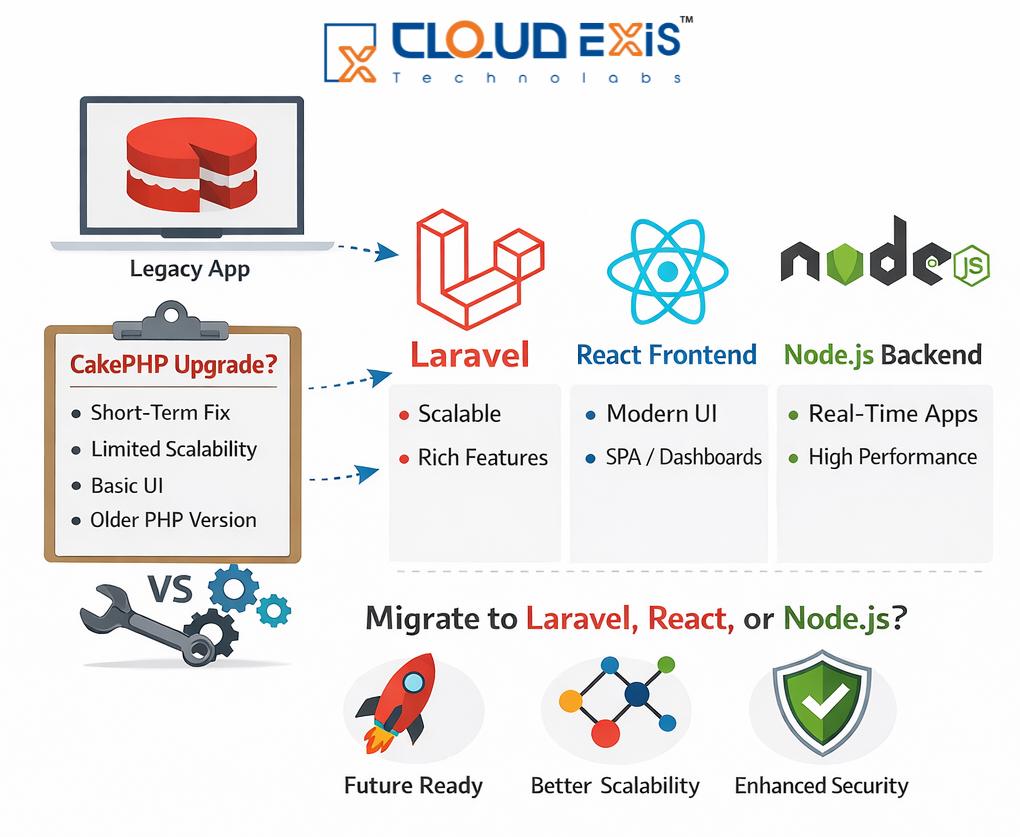
Should we upgrade CakePHP or move to a modern stack altogether?
Option 1: Upgrading CakePHP to the Latest Version
Upgrading CakePHP (for example from 2.x → 4.x or 5.x) can be the right move in specific cases.
When a CakePHP Upgrade Makes Sense
Your app logic is stable and business-critical
Minimal frontend complexity
Limited third-party integrations
No immediate need for mobile apps or SPAs
Tight timelines or limited budgets
Benefits of a CakePHP Upgrade
Improved performance and security
Cleaner codebase
Better PHP compatibility (PHP 8+)
Reduced technical debt
Faster than full migration
Challenges of CakePHP Upgrades
Major breaking changes between versions
Deprecated components and helpers
Time-consuming refactoring
Still a limited ecosystem compared to Laravel
Frontend remains tightly coupled
A CakePHP upgrade is often a short-term optimization, not a long-term growth strategy.
Option 2: Migrating from CakePHP to Laravel
Laravel has become the dominant PHP framework due to its flexibility, scalability, and developer ecosystem.
Why Businesses Prefer Laravel in 2026
Clean, expressive syntax
Powerful ORM (Eloquent)
Built-in REST API support
Large developer community
Excellent documentation
Easy third-party integrations
Strong security features
Ideal Scenarios for CakePHP → Laravel Migration
Long-term product roadmap
SaaS or B2B platforms
API-first architecture
Need for faster feature delivery
Better hiring and scalability
What Changes During Migration
Controllers and models are rewritten
Views are often modernized or decoupled
Database structure optimized
Authentication and authorization rebuilt
APIs standardized
Business Benefits of Laravel Migration
Faster development cycles
Improved performance and maintainability
Better integration with React, Vue, or mobile apps
Easier onboarding of new developers
Laravel migration is a future-proof investment, not just a technical upgrade.
Option 3: Modernizing with React (Frontend Upgrade)
Many CakePHP applications struggle not because of backend logic, but because of outdated UI and poor user experience.
This is where React plays a major role.
Why React Is a Game Changer
Lightning-fast UI updates
Component-based architecture
Perfect for dashboards and admin panels
Ideal for SaaS and enterprise apps
Seamless API integration
Common Migration Pattern
Instead of replacing everything at once:
Keep CakePHP or Laravel as backend
Introduce React as frontend
Build REST or GraphQL APIs
Gradually modernize features
Benefits of Adding React
Modern, responsive UI
Better user engagement
Faster page loads
Mobile-friendly experience
Easier future mobile app development
React modernization is often the lowest-risk, highest-impact upgrade.
Option 4: Migrating to Node.js for High-Scale Applications
For real-time, event-driven, or high-concurrency systems, Node.js is a powerful alternative.
When Node.js Makes Sense
Real-time dashboards
Chat or notification systems
Streaming or IoT platforms
High-traffic APIs
Microservices architecture
Advantages of Node.js Migration
Non-blocking, asynchronous performance
Excellent for real-time applications
Same language for frontend and backend (JavaScript)
Scales efficiently with traffic growth
Typical Node.js Migration Approach
Identify performance-critical modules
Rewrite selected services in Node.js
Run a hybrid architecture (PHP + Node)
Gradually move toward microservices
Node.js migration is ideal for scale-focused products, not simple CRUD systems.
How Cloudexis Technolabs LLP Handles CakePHP Modernization
At Cloudexis Technolabs LLP, we don’t believe in one-size-fits-all solutions.
Our approach focuses on business goals first, technology second.
Our Step-by-Step Process
Codebase Audit
CakePHP version analysis
Security and performance review
Database and architecture assessment
Modernization Strategy
Upgrade vs migration recommendation
Cost and timeline estimation
Risk assessment
Phase-Wise Execution
Zero-downtime migration planning
Feature-by-feature rollout
Parallel system testing
UI & Performance Optimization
React-based frontend (optional)
API optimization
Server and database tuning
Post-Launch Support
Monitoring
Bug fixes
Future scalability planning
Real-World Use Cases We Handle
CakePHP 2.x → Laravel 10+ migration
CakePHP backend + React admin dashboard
Legacy monolith → API-driven architecture
PHP system enhanced with Node.js microservices
Gradual modernization without business disruption
Final Thoughts: Upgrade or Migrate?
If your goal is short-term stability, a CakePHP upgrade may work.
If your goal is growth, scalability, and future readiness, migration is the smarter move.
Businesses that modernize early gain:
Faster feature releases
Better user experience
Improved security
Lower long-term costs