Many businesses today still rely on applications built on CakePHP, Zend Framework, CodeIgniter (CI), or Custom PHP. These platforms once powered fast growth and stable operations—but in 2026, they often struggle to keep up with modern performance, security, scalability, and integration demands.
If your PHP application feels difficult to maintain, slow to scale, or limited in adding new features, it’s a clear sign that legacy PHP modernization should be part of your digital roadmap.
This blog explains how to upgrade or migrate legacy PHP applications the right way, without disrupting your business while keeping SEO, performance, and long-term ROI in focus.
Why Legacy PHP Applications Need Modernization Today
Legacy PHP frameworks are not “bad,” but they were designed for a different era of web development.
Common Issues with Legacy PHP Systems
Applications built on older versions of CakePHP, Zend, CI, or Custom PHP often face:
Compatibility issues with newer PHP versions
Increasing security vulnerabilities
Poor scalability during traffic spikes
Tight coupling between frontend and backend
Limited API support
Outdated UI/UX affecting conversions
Difficulty hiring developers for older stacks
High maintenance cost with low innovation speed
At this stage, upgrading or migrating is not just a technical decision. It’s a business survival strategy.
Understanding Your Legacy PHP Stack Before Taking Action
Before deciding whether to upgrade or migrate, it’s important to understand what kind of legacy system you have.
Common Legacy PHP Scenarios
CakePHP applications with tightly coupled MVC and legacy helpers
Zend Framework projects with complex service layers and outdated architecture
CodeIgniter (CI) systems lacking modular structure and scalability
Custom PHP applications without coding standards, MVC, or security layers
Each of these requires a different modernization approach.
Upgrade vs Migration: What’s the Real Difference?
PHP Framework Upgrade
Upgrading means staying within the same ecosystem:
CakePHP → latest CakePHP
Zend → Laminas
CI 3 → CI 4
Best for:
Stable internal systems
Limited user base
Short-term improvements
Limitations:
Doesn’t fully solve scalability
UI often remains outdated
Future migration still likely
PHP Application Migration
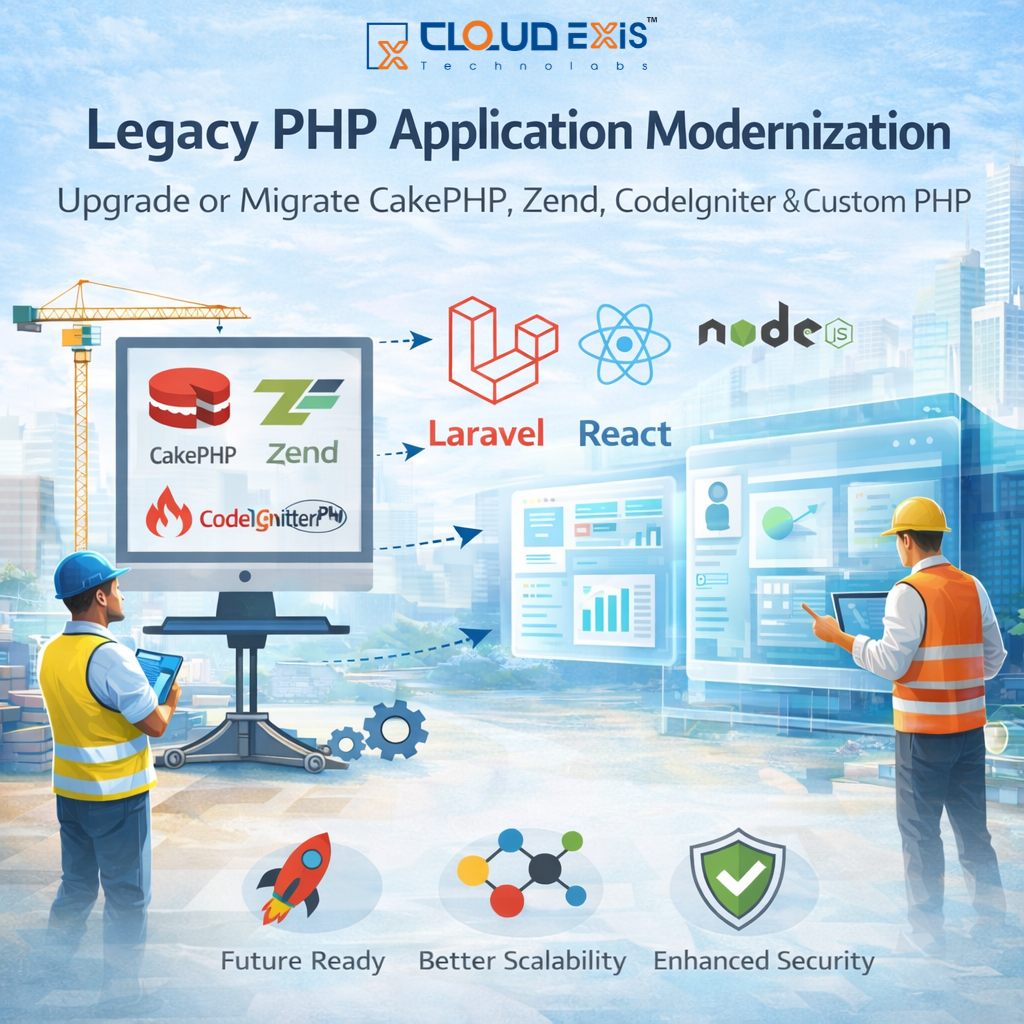
Migration involves moving to a modern, future-ready stack, typically:
CakePHP / Zend / CI / Custom PHP → Laravel
Frontend modernization using React
High-performance services using Node.js
Best for:
SaaS products
B2B platforms
Customer-facing systems
Long-term growth planning
Migration delivers real architectural transformation, not just fixes.
Step 1: Legacy PHP Application Audit (SEO + Performance Focus)
A successful PHP modernization project starts with a technical and business audit.
What We Audit
Framework version (CakePHP, Zend, CI, Custom PHP)
PHP compatibility and upgrade readiness
Database design and data volume
Core business workflows
Authentication and authorization logic
Third-party integrations
Performance bottlenecks
Security risks
SEO impact (URLs, redirects, indexing)
This audit prevents costly rework later.
Step 1: Legacy PHP Application Audit (SEO + Performance Focus)
A successful PHP modernization project starts with a technical and business audit.
What We Audit
Framework version (CakePHP, Zend, CI, Custom PHP)
PHP compatibility and upgrade readiness
Database design and data volume
Core business workflows
Authentication and authorization logic
Third-party integrations
Performance bottlenecks
Security risks
SEO impact (URLs, redirects, indexing)
This audit prevents costly rework later.
Step 2: Choosing the Right Modernization Strategy
There is no one-size-fits-all solution. Below are the most effective modernization paths for legacy PHP applications.
Strategy 1: Incremental PHP Migration (Low Risk, High Control)
Best for live, revenue-generating applications
Keep legacy CakePHP / Zend / CI running
Introduce Laravel or Node.js modules gradually
Convert legacy logic into APIs
Migrate features in phases
Strategy 2: Frontend Modernization with React
Best for outdated UI/UX
Keep backend temporarily
Introduce React frontend
Improve speed, UX, and engagement
Prepare for future backend migration
Strategy 3: Full Migration to Laravel or Node.js
Best for heavily outdated systems
Rebuild backend architecture
Implement API-first design
Modern authentication and security
Scalable database and caching layers
Strategy 4: Hybrid Enterprise Modernization
Best for large platforms
Phase 1: React UI
Phase 2: Laravel APIs
Phase 3: Node.js microservices
Phase 4: Decommission legacy PHP modules
This ensures zero downtime and steady growth.
Step 3: Modern Architecture for PHP Applications
Modern PHP applications are decoupled, scalable, and API-driven.
Key Architecture Components
API-first backend (Laravel / Node.js)
Decoupled frontend (React)
Centralized authentication
Modular services
Cloud-ready deployment
CI/CD pipelines
Monitoring & logging
This architecture works whether you migrate from CakePHP, Zend, CI, or Custom PHP.
Step 3: Modern Architecture for PHP Applications
Modern PHP applications are decoupled, scalable, and API-driven.
Key Architecture Components
API-first backend (Laravel / Node.js)
Decoupled frontend (React)
Centralized authentication
Modular services
Cloud-ready deployment
CI/CD pipelines
Monitoring & logging
This architecture works whether you migrate from CakePHP, Zend, CI, or Custom PHP.
Step 4: Secure Data Migration Without Losing Trust
Data migration is the most sensitive phase of any PHP modernization project.
Best Practices
Validate and clean legacy data
Maintain schema compatibility
Run parallel databases temporarily
Perform dry-run migrations
Implement rollback strategies
Preserve SEO data (URLs, slugs, metadata)
Never rush data migration, business trust depends on it.
Step 5: Security & Compliance Upgrade
Legacy PHP applications often lack modern security standards.
Modernization allows implementation of:
Token-based authentication (JWT, OAuth)
Role-based access control
Secure API gateways
Encrypted sensitive data
Activity logs and monitoring
Protection against OWASP threats
Security upgrades also improve customer confidence and compliance readiness.
Step 6: Performance Optimization After Migration
Modernization should deliver measurable results.
Performance Improvements Include
Optimized database queries
Caching layers (Redis / Memcached)
Background job queues
CDN integration
Load balancing
Horizontal scaling
These improvements directly impact SEO rankings and user retention.
Step 7: Testing Strategy for Modern PHP Applications
Testing ensures your new system is better, not just newer.
Must-Have Testing Layers
Unit testing
API testing
UI regression testing
Load testing
Security testing
Testing reduces post-launch risks and protects SEO stability.
Step 8: Cost, Timeline & Resource Planning
Typical Timelines
Small PHP apps: 6–10 weeks
Medium platforms: 3–5 months
Enterprise systems: 6+ months (phased)
Cost Depends On
Code quality
Data complexity
Integration count
Custom logic
SEO preservation needs
Planning avoids unexpected overruns.
Common Mistakes in Legacy PHP Modernization
Rewriting everything at once
Ignoring SEO during migration
Choosing technology based on hype
Skipping documentation
Underestimating QA efforts
No rollback plan
Avoiding these mistakes saves months of effort.
How Cloudexis Technolabs LLP Helps Modernize Legacy PHP Applications
At Cloudexis Technolabs LLP, we specialize in:
CakePHP upgrade & migration
Zend / Laminas modernization
CodeIgniter (CI) application migration
Custom PHP application modernization
Our approach focuses on:
SEO-safe migration
Minimal downtime
Phased execution
Scalable architecture
Long-term maintainability
We don’t just modernize code. We future-proof businesses.
Final Thoughts
Legacy PHP applications built on CakePHP, Zend, CI, or Custom PHP still hold valuable business logic. Modernization is about unlocking that value for the future, not replacing it blindly. Content Us
With the right strategy, you can:
Reduce technical debt
Improve SEO and performance
Enhance security
Scale with confidence
Prepare for AI, SaaS, and mobile expansion