Using Node.js and TensorFlow.js for Real-Time Machine Learning Predictions
Artificial Intelligence is becoming the backbone of modern digital products. Whether it’s personalized recommendations on e-commerce platforms, real-time fraud detection in fintech, predictive alerts in IoT devices, or live sentiment analysis in chat systems, machine learning is now integrated into almost every business process.
For developers and companies who rely on JavaScript, the rise of Node.js AI integration combined with TensorFlow.js has opened a completely new era. You can now build, deploy, and serve real-time machine learning predictions using the same language that powers the modern web: JavaScript.
This blog explores how Node.js and TensorFlow.js work together, why they are ideal for real-time ML applications, practical use cases across industries, and best practices for building scalable AI systems.
1. Why Node.js Is Perfect for Real-Time Machine Learning APIs
Node.js has transformed how modern applications are built. Its event-driven, non-blocking architecture makes it extremely efficient for handling multiple simultaneous requests—an essential requirement for applications that need real-time responses from ML models.
Here’s why Node.js is a strong choice:
1.1 Non-Blocking Architecture for Instant ML Predictions
Real-time machine learning requires quick inference. Node’s event loop ensures:
No waiting for slow operations
Multiple predictions handled concurrently
High throughput with low latency
This is especially useful for businesses offering live recommendations, chatbots, or predictive dashboards.
1.2 One Language Across Entire Stack
Traditionally, ML development depended heavily on Python. With TensorFlow.js:
Your backend (Node.js)
Your frontend (React, Vue, Angular)
Your ML model usage can all use JavaScript.
This reduces onboarding, improves development speed, and unifies the full-stack workflow.
1.3 Massive Ecosystem Support
Node.js has libraries for:
Real-time communication (Socket.io)
APIs (Express, Fastify)
Data streaming
Microservices
Cloud deployment
Pair this with TensorFlow.js, and you have an extremely flexible ML runtime.
1.4 Ideal for Cloud & Serverless AI
Platforms like:
AWS Lambda
Google Cloud Run
Vercel
Netlify
allow you to deploy Node.js ML services instantly.
This aligns perfectly with real-time AI workloads where scalability matters.
2. What Is TensorFlow.js and Why Does It Matter?
TensorFlow.js is a machine learning framework built specifically for JavaScript. It supports:
Running models in the browser
Running models in Node.js
Training models on the server or client
Using pre-trained models instantly
Accelerated predictions using CPU, GPU, and WebGL
This means you don’t need to rely solely on Python-based ML pipelines. If your goal is real-time inference, TensorFlow.js gives you everything you need.
2.1 Pretrained Models Ready to Use
TensorFlow.js includes ready-to-use models for:
Image classification
Object detection
Pose estimation
Sentiment analysis
Text toxicity classification
Face landmark detection
Speech recognition
This drastically shortens development time and allows businesses to adopt AI more quickly.
2.2 Runs on Both Browser and Server
Node.js + TensorFlow.js enables:
Server-side ML API processing
Browser-side predictions without backend
Hybrid ML workflows
Edge computing deployment
This flexibility helps teams design ML systems that suit their business needs.
3. How Real-Time Machine Learning Works in Node.js
Real-time machine learning means predictions happen instantly when new data arrives. In practical terms, this requires:
A fast backend
An optimized ML model
Lightweight preprocessing
Low-latency responses
Node.js acts as the “prediction engine” where TensorFlow.js runs inference on demand.
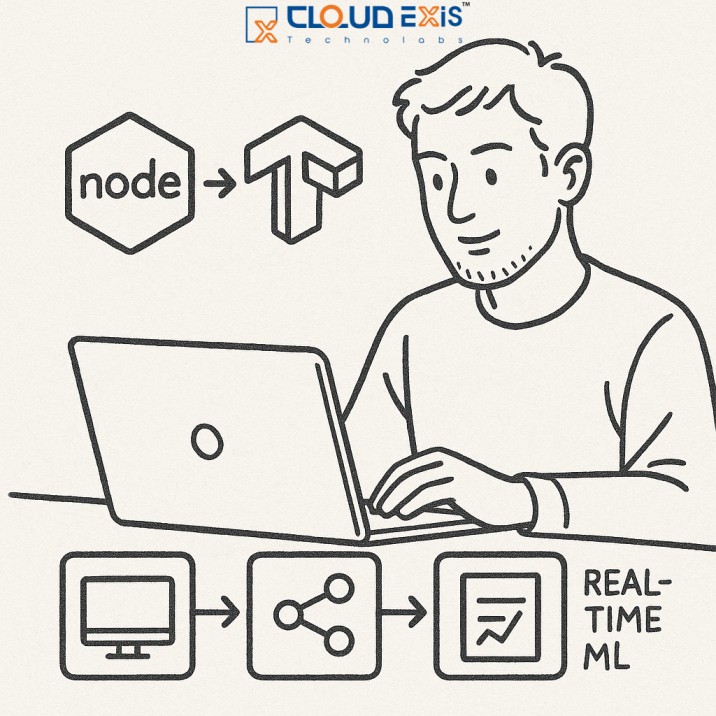
3.1 Real-Time Workflow Overview
A typical flow looks like:
Client sends input data
Node.js receives the request
TensorFlow.js interprets the data using an ML model
The prediction is generated within milliseconds
The response is returned instantly
This architecture supports millions of predictions per day if scaled correctly.
3.2 Benefits of Real-Time ML
Better user experience
Instant decision-making
Accurate predictions using latest data
Adaptive user interfaces
More value-driven automation
Modern SaaS tools, fintech apps, and IoT platforms rely heavily on these advantages.
4. Real-World Use Cases of Node.js + TensorFlow.js
Node.js and TensorFlow.js together open possibilities across many industries. Below are some real-world applications where real-time ML plays a crucial role.
4.1 Real-Time NLP and Chatbots
Natural Language Processing (NLP) is one of the biggest application areas.
Node.js is already widely used for:
Chat APIs
WhatsApp automation
Customer support bots
Messaging platforms
Adding TensorFlow.js enables:
Real-time sentiment analysis
Toxicity detection
Auto-reply generation
Intent classification
Context understanding
This combination powers smarter chat systems that respond intelligently within milliseconds.
4.2 Computer Vision & Image Processing
TensorFlow.js includes pre-trained models for:
Object detection
Face recognition
Pose tracking
Image classification
OCR-like features
Node.js can process images coming from:
Mobile apps
CCTV cameras
IoT devices
E-commerce product uploads
This enables real-time features like:
Detecting suspicious activity in security systems
Verifying identity in fintech apps
Recognizing products during warehouse scanning
Quality inspection in manufacturing
4.3 Real-Time Recommendations in E-Commerce
Every major ecommerce platform relies on ML to:
Show recommended products
Predict user preferences
Personalize home feeds
Suggest combos based on purchase history
Node.js handles incoming traffic extremely well, while TensorFlow.js calculates predictions quickly.
This creates a fluid shopping experience powered by:
Live behavioral tracking
Intelligent ranking
Predictive product affinity scoring
4.4 Predictive Analytics in SaaS Products
Modern SaaS tools need real-time dashboards and predictive intelligence. Node.js + TensorFlow.js enables:
Predicting KPI trends
Predicting customer churn
Triggering alerts based on anomalies
Predicting sales and demand
Real-time scoring models
This gives B2B platforms a competitive edge.
4.5 Real-Time IoT and Edge AI
IoT requires instant responses.
Paired with TensorFlow.js, Node.js can:
Process sensor readings
Detect anomalies
Predict equipment failure
Trigger alarms
Automate workflows
This helps industries like smart farming, manufacturing, transportation, and energy.
5. The Architecture Behind Real-Time ML with Node.js
A well-designed architecture ensures that your ML predictions stay accurate, fast, and scalable.
Below is the recommended high-performance architecture:
5.1 Server-Side Inference Layer
Node.js initializes the ML model once during server startup. This avoids repeated loading and boosts performance.
Your API then becomes:
Fast
Stable
Always ready
5.2 Scaling Using Multiple Workers or Microservices
To handle heavy workloads, Node.js can:
Spawn multiple worker threads
Run multiple containerized services
Distribute prediction load across nodes
Run separate microservices for vision, NLP, and forecasting
This ensures high availability and low latency.
5.3 GPU-Enabled Machines
Since TensorFlow.js supports GPU acceleration:
Predictions become faster
More complex ML models can run smoothly
Processing remains stable under peak loads
Cloud providers offer GPU instances that make this extremely feasible.
5.4 Caching for Faster Repeated Predictions
Caching results significantly boosts performance for repeated requests. Techniques include:
In-memory caching
Redis caching
Edge caching
Frequently used values return instantly.
6. Best Practices for Node.js + TensorFlow.js Machine Learning
To achieve maximum performance and accuracy, businesses should follow these recommended best practices:
6.1 Load the ML Model Only Once
Loading the model repeatedly slows everything down. Best practice:
Load model during server startup
Reuse the model for all predictions
This reduces response time from seconds to milliseconds.
6.2 Use Lightweight Models for Real-Time Apps
Heavy models slow down inference. Use:
Smaller network sizes
Optimized architectures
Pruned or quantized models
Pre-trained models where possible
This ensures faster responses.
6.3 Run Preprocessing Steps Efficiently
Real-time ML often depends heavily on:
Cleaning input
Normalizing data
Reshaping
Feature extraction
Ensure these operations are optimized for speed.
6.4 Use Worker Threads for CPU-Heavy ML Tasks
CPU-heavy ML tasks can block the Node.js main thread. Using worker threads avoids performance drops.
6.5 Scale Horizontally for Large Traffic
Real-time apps need to handle sudden traffic spikes. Node.js microservices can be scaled horizontally anytime using:
Kubernetes
Docker
Load balancers
6.6 Monitor Model Performance Continuously
Machine learning performance drops over time as real-world data changes.
You must regularly monitor:
Prediction accuracy
Latency
Error patterns
Model drift
This ensures your real-time AI stays reliable.
7. Future of AI with Node.js and TensorFlow.js
AI in JavaScript is evolving at a fast pace.
7.1 More Pretrained Models
Soon we will see:
Better speech models
More advanced vision models
Improved sentiment detection
More domain-specific ML models
7.2 Edge AI Powered by WebGPU
With advances in WebGPU:
Browser performance will improve
On-device ML will be faster
Less backend dependency
Better privacy by local predictions
7.3 AI for Serverless Functions
Serverless AI is becoming mainstream. Node.js will lead this wave because:
Cold starts are minimal
Inference is instant
Deployment is effortless
7.4 Integration with LLMs and Vector Databases
Node.js will increasingly handle:
AI chatbots
Contextual search
Retrieval-Augmented Generation (RAG)
Hybrid ML + LLM systems
This makes JavaScript a full AI ecosystem.
Conclusion: A Powerful Combination for the Future of AI
Node.js and TensorFlow.js together create a robust, modern, and scalable environment for real-time machine learning predictions. With Node.js handling fast incoming traffic and TensorFlow.js powering ML inference, businesses can deploy AI-powered features with incredible speed and efficiency.
Final Takeaways:
Node.js offers unmatched speed for real-time interoperability
TensorFlow.js enables ML directly in JavaScript
Together they form a complete AI integration stack
Ideal for building predictive, intelligent, and automated systems
Perfect for SaaS, IoT, fintech, e-commerce, and enterprise AI
Supports browser ML, server ML, and hybrid ML workflows
Whether you’re a developer, a startup founder, or a tech leader planning to integrate AI into your product, Node.js + TensorFlow.js is the future-proof approach to deliver real-time intelligence at scale. Let’s have a virtual Coffee